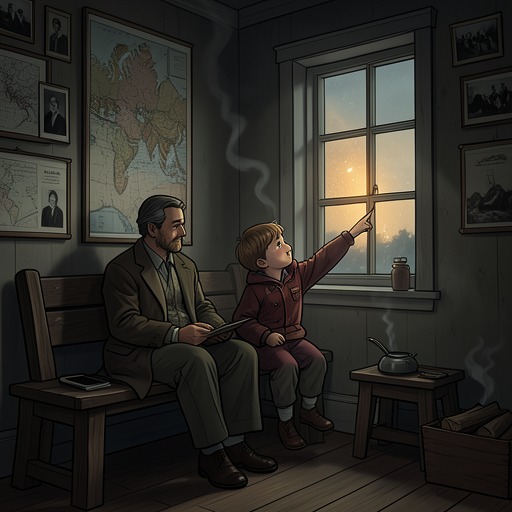
Continuing Aeron’s Dragon Quest
The Ballad of the Last DragonContinuing Aeron’s Dragon Quest is the pivotal decision by Aeron Fowler’s surviving companions to complete his expedition after his death. Sylvaine Abelan turns mourning into a plan: the company will find the dragon, preserve Aeron’s reputation, and make his unfinished journey appear to end in the heroic death he could no longer achieve himself. The decision binds practical survival, loyalty, performance, and deliberate deception into one undertaking.
Causes and Stakes
The proposal begins with Sylvaine Abelan’s recognition that Aeron Fowler’s death has left the company without its leader but not without his supplies, destination, funding, or purpose. She presents continuation as a way to honor him rather than abandon the quest, while also acknowledging the material motives beneath that ideal. The company can still be paid, and Aeron’s resources can support the journey; the distinction Sylvaine insists upon is that using them for his mission is not theft but the fulfillment of his intentions.
The decision carries several overlapping stakes. Aeron wished to complete the dragon quest and return home with his honor restored, while the surviving company members need the expedition’s second payment. Sylvaine also frames the journey as a means of securing Neith’s long-term comfort. Jaromir understands that Aeron would have wanted the group to press forward despite catastrophe, and that he would have wanted Neith to be cared for permanently. The quest therefore becomes at once a memorial obligation, a financial gamble, and a promise to the living.
The Proposed Continuation
Sylvaine’s proposition to Jaromir is direct: the company will carry on to the end, complete Aeron’s quest, collect the money, and offer its proceeds to his sister-in-law and nieces while elevating Aeron’s name into lasting glory. She asks what Aeron himself would have wanted, and Jaromir’s response confirms the emotional foundation of the plan. He believes Aeron would have insisted that the work be finished regardless of fire, flood, or danger.
The proposal does not pretend that the group can simply replace Aeron in ordinary fashion. Sylvaine instead designs a sustained fiction around his continued presence. She will write and sing ballads in his name, amplify accounts of his exploits, and spread those stories through inns and taverns. The company may also take other contracts and complete them under Aeron’s name, allowing his reputation to grow through repeated performance. Because strangers do not know Aeron’s appearance, his absence from the tavern can be explained away whenever necessary.
The most extreme part of the scheme is reserved for the journey’s conclusion. After Aeron’s name has gained enough public force to pressure his brother into restoring his honor, the company will announce that Aeron died bravely while bringing down the dragon. The quest is thus designed not merely to finish an expedition but to manufacture a heroic ending for a dead man. Its success depends on the dragon being found, the story being believed, and the final deception producing the recognition Aeron had been denied.
Agreement and Immediate Response
The proposal initially produces stunned silence. Sylvaine keeps her head raised under the company’s scrutiny, accepting that the plan may be judged as an insult to Aeron’s memory. Her defense is that the deception does not sully him because it fulfills his wishes and gives him the heroic welcome home he deserved.
Cadoc’s first practical objection concerns payment. Aeron had been fully outfitted and had carried the funds for the journey, including the first half of the company’s compensation; the remaining half was to be collected when the expedition was completed. Sylvaine proposes that the survivors claim that second payment after bringing news of Aeron’s heroic death to his brother. She recognizes that this is the weakest part of the arrangement because Aeron’s family has made no guaranteed promise to honor the bargain after his death.
Neith doubts that Arnorr will give them even a copper, but she agrees with the rest of the proposal because Aeron would have wanted the work completed. Her acceptance, conveyed through a restrained nod and a visibly tense response, gives Sylvaine the confirmation she needs. Cadoc follows her in supporting the plan, even while continuing to argue with Jaromir about what defending Aeron’s honor will require. The company’s agreement is therefore practical rather than unanimous in confidence: they accept uncertainty about payment while committing themselves to the larger purpose.
Consequences and Narrative Significance
The decision changes the company’s relationship to truth. From this point, Aeron’s absence is not simply a wound they carry; it becomes a condition they must manage through explanations, songs, tavern performances, and carefully controlled public appearances. His identity is converted into a story that the survivors must continually maintain, making artistic invention part of the expedition’s operational method.
The event also converts mourning into agency. Aeron cannot personally slay the dragon, reclaim his status, or return to his family, but the survivors can act in his name. Sylvaine’s promise is consequently both a vow and a performance: she will bring Aeron honor, and she will fight his dragon. The wording joins moral commitment to physical danger, establishing that the company’s future actions will be judged against a promise made in the immediate aftermath of loss.
As a narrative turning point, the continuation reverses the expected shape of a heroic quest. The conventional hero is dead before the dragon is defeated, so his companions must construct the missing stages of his legend on his behalf. The group’s journey becomes a memorial campaign whose final reward is not only treasure or payment but control over the meaning of Aeron Fowler’s death. The dragon remains a literal objective, yet the deeper conflict is over whether a dead man can be restored to honor through the living people who remember, imitate, and publicly retell his life.